

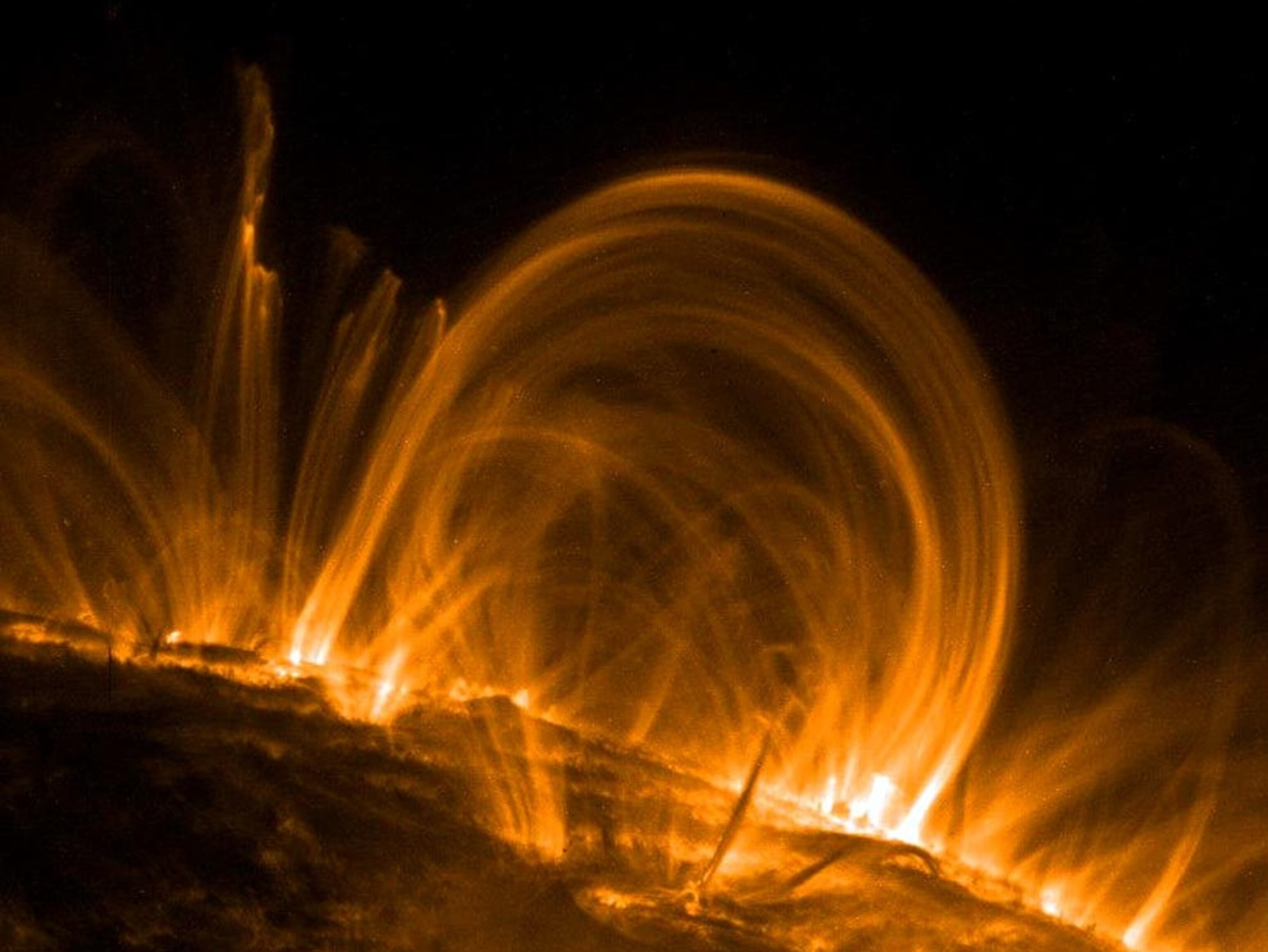


Compared with the billions of other stars in the universe, the sun is unremarkable. But for Earth and the other planets that revolve around it, the sun is a powerful center of attention. It holds the solar system together; provides life-giving light, heat, and energy to Earth; and generates space weather.
Characteristics of the sun
The sun resides some 26,000 light-years from the Milky Way's center, in a tendril of our home galaxy known as the Orion Arm. Every 230 million years, the sun—and the solar system it carries with it—makes one orbit around the Milky Way's center. Though we can't feel it, the sun traces its orbit at an average velocity of 450,000 miles an hour.
The sun formed more than 4.5 billion years ago, when a cloud of dust and gas called a nebula collapsed under its own gravity. As it did, the cloud spun and flattened into a disk, with our sun forming at its center. The disk's outskirts later accreted into our solar system, including Earth and the other planets. Scientists have even managed to see these planet-birthing disks around our sun's distant young cousins.
Our home star is a yellow dwarf, a medium-size variety that's fairly common in our galaxy. The label “yellow” is misleading, though, since our sun burns a bright white. On Earth, the sun can take on warmer hues, especially at sunrise or sunset, because our planet's atmosphere scatters blue and green light the most.
From our perspective, “dwarf” might not be the best word for our sun, either. At about 864,000 miles (1.4 million kilometers) wide, the sun is 109 times wider than Earth, and it accounts for more than 99.8 percent of the solar system's total mass. If it was a hollow ball, more than a million Earths could fit inside it. But the sun isn't hollow: It's filled with scorching gases and soups of electrically charged particles called plasma. The sun's surface temperature is about 10,000 degrees Fahrenheit (5,500 degrees Celsius), and it's 27 million degrees Fahrenheit (15.5 million Celsius) at the core.
Deep in the sun's core, nuclear fusion converts hydrogen to helium, which generates energy. Particles of light called photons carry this energy through a spherical shell called the radiative zone to the top layer of the solar interior, the convection zone. There, hot plasmas rise and fall like the ooze in a lava lamp, which transfers energy to the sun's surface, called the photosphere.
It can take 170,000 years for a photon to complete its journey out of the sun, but once it exits, it zips through space at more than 186,000 miles a second. Solar photons reach Earth about eight minutes after they're freed from the sun's interior, crossing an average of 93 million miles to get here—a distance defined as one astronomical unit (AU).


Out beyond the sun's photosphere lies the atmosphere, which consists of the chromosphere and the solar corona. The chromosphere looks like a reddish glow fringing the sun, while the corona's huge white tendrils extend millions of miles long. The chromosphere and corona also emit visible light, but on Earth's surface, they can be seen only during a total solar eclipse, when the moon passes between Earth and the sun.
The corona runs far hotter than the photosphere, hitting temperatures of more than a million degrees Fahrenheit. How the corona gets so hot remains a scientific mystery, which is partly why NASA launched its Parker Solar Probe, the fastest spacecraft ever built, and the first ever sent into the corona. (Read more about the spacecraft that will “touch the sun.”)
Solar wind and flares
In addition to light, the sun radiates heat and a steady stream of charged particles known as the solar wind. The wind blows about 280 miles (450 kilometers) a second throughout the solar system, extending the sun's magnetic field out more than 10 billion miles. Beyond that distance, the solar wind gives way to the colder, dense material that drifts in between stars, forming a boundary called the heliopause. So far, just two spacecraft—Voyager 1 and Voyager 2—have crossed this cosmic threshold, which defines the start of interstellar space.
Every so often, a patch of particles will burst from the sun in a solar flare, which can disrupt satellite communications and knock out power on Earth. Flares usually stem from the activity of sunspots, cool regions of the photosphere that form and dissipate as the sun's internal magnetic field shifts. Solar flares and sunspots obey a regular cycle, rising and falling in number every 11 years as the poles of the sun's magnetic field flip back and forth.
Sometimes, the sun will also launch huge bubbles of magnetized particles from its corona, in events called coronal mass ejections (CMEs). Some CMEs can grow as large as the sun itself and fling as much as a billion tons of material in a given direction. As they rush from the sun, CMEs can send huge shockwaves through the solar wind. If a CME collided with Earth, its particles could pack enough power to fry electronics in orbit and on Earth's surface.
Like many energy sources, the sun will not last forever. It has already used up nearly half of the hydrogen in its core. The sun will continue to burn through the hydrogen for another five billion years or so, and then helium will become its primary fuel. At that point, the sun will expand to about a hundred times its current size, swallowing Mercury and Venus—and maybe Earth. It will burn as a red giant star for another billion years and then collapse into a white dwarf star.
Related Topics
You May Also Like




Go Further
Animals
- How can we protect grizzlies from their biggest threat—trains?How can we protect grizzlies from their biggest threat—trains?
- This ‘saber-toothed’ salmon wasn’t quite what we thoughtThis ‘saber-toothed’ salmon wasn’t quite what we thought
- Why this rhino-zebra friendship makes perfect senseWhy this rhino-zebra friendship makes perfect sense
- When did bioluminescence evolve? It’s older than we thought.When did bioluminescence evolve? It’s older than we thought.
- Soy, skim … spider. Are any of these technically milk?Soy, skim … spider. Are any of these technically milk?
Environment
- Are the Great Lakes the key to solving America’s emissions conundrum?Are the Great Lakes the key to solving America’s emissions conundrum?
- The world’s historic sites face climate change. Can Petra lead the way?The world’s historic sites face climate change. Can Petra lead the way?
- This pristine piece of the Amazon shows nature’s resilienceThis pristine piece of the Amazon shows nature’s resilience
- Listen to 30 years of climate change transformed into haunting musicListen to 30 years of climate change transformed into haunting music
History & Culture
- Meet the original members of the tortured poets departmentMeet the original members of the tortured poets department
- Séances at the White House? Why these first ladies turned to the occultSéances at the White House? Why these first ladies turned to the occult
- Gambling is everywhere now. When is that a problem?Gambling is everywhere now. When is that a problem?
- Beauty is pain—at least it was in 17th-century SpainBeauty is pain—at least it was in 17th-century Spain
Science
- Here's how astronomers found one of the rarest phenomenons in spaceHere's how astronomers found one of the rarest phenomenons in space
- Not an extrovert or introvert? There’s a word for that.Not an extrovert or introvert? There’s a word for that.
- NASA has a plan to clean up space junk—but is going green enough?NASA has a plan to clean up space junk—but is going green enough?
- Soy, skim … spider. Are any of these technically milk?Soy, skim … spider. Are any of these technically milk?
Travel
- This tomb diver was among the first to swim beneath a pyraamidThis tomb diver was among the first to swim beneath a pyraamid
- Dina Macki on Omani cuisine and Zanzibari flavoursDina Macki on Omani cuisine and Zanzibari flavours
- How to see Mexico's Baja California beyond the beachesHow to see Mexico's Baja California beyond the beaches
- Could Mexico's Chepe Express be the ultimate slow rail adventure?Could Mexico's Chepe Express be the ultimate slow rail adventure?
