-
Turbulent Star
Image courtesy SOHO/ESA/NASA
A close-up of the sun from 1999 shows how solar plasma is constantly in motion, giving the star a textured appearance.
As the sun's magnetic field lines get tangled, they create clusters of stronger magnetic activity that push around the sun's surface plasma. These so-called active regions are seen as bright spots in the extreme ultraviolet image above.
A large solar prominence—a cloud of plasma suspended by the sun's magnetic forces—is seen erupting at upper right.
-
Magnetic Loops
Image courtesy SDO/NASA
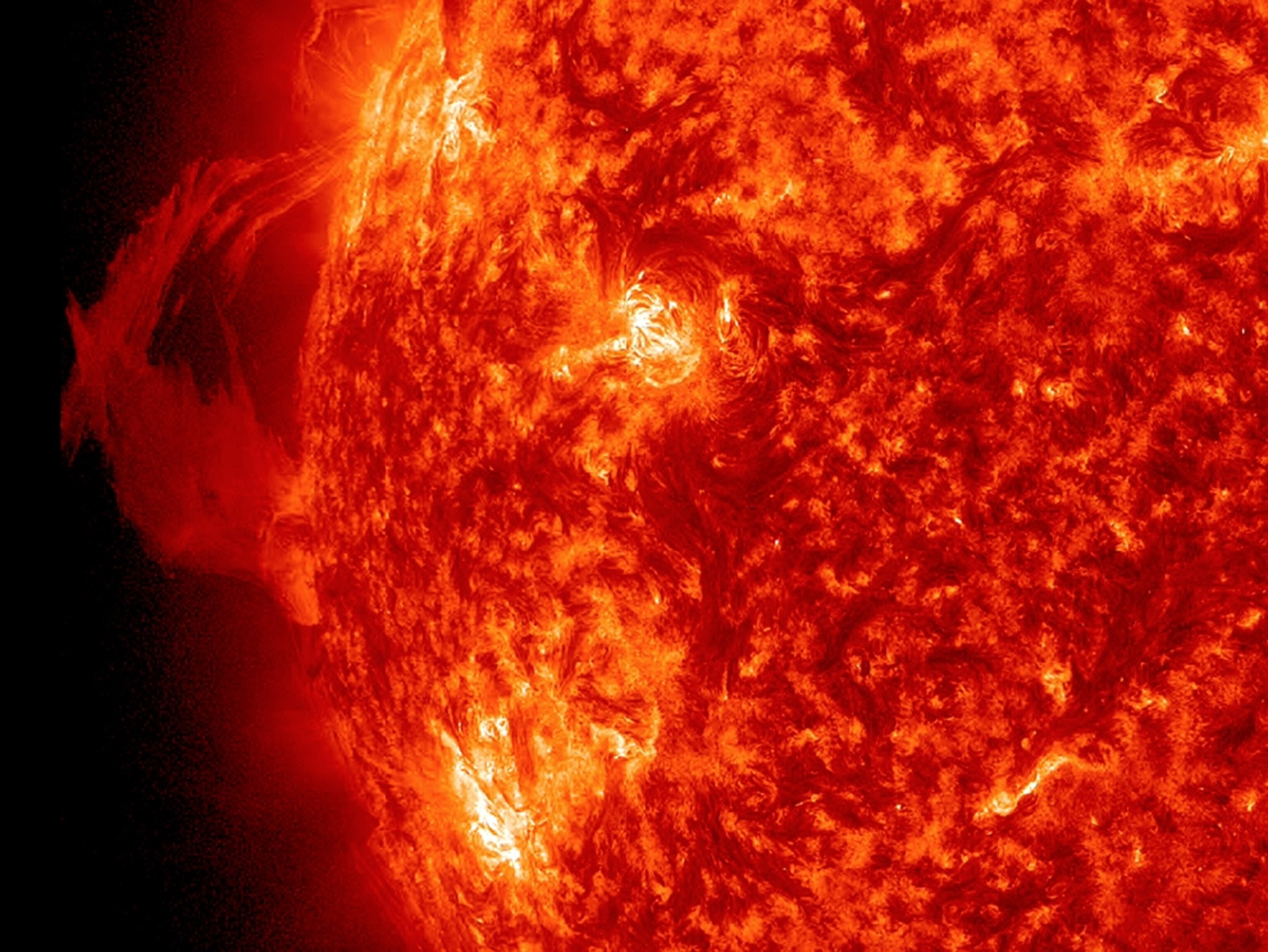
An extreme ultraviolet picture taken by a NASA satellite in February 2011 captured the beginnings of a solar flare—a powerful burst of radiation from the sun. The image revealed that the root of the flare was made up of many fine loops of plasma.
Such plasma loops trace the sun's normally invisible magnetic field lines, helping scientists visualize the connections between magnetically active regions on the solar surface.
-
Sunspot Cluster
Image courtesy SOHO/ESA/NASA
Dark, planet—size blemishes on the surface of the sun are knots of intense magnetic activity called sunspots, some of which are seen above in a September 2000 picture from a NASA satellite. The spots appear dark in visible light because they are slightly cooler than the surrounding regions.
Sunspots often travel in groups across the solar surface and can linger for days or even months. The spots are the birthplaces of solar events such as flares and coronal mass ejections.
-
Visible Spots
Photograph courtesy Fabiano Belisario Diniz
Some sunspots are so large that they are visible from Earth even without the aid of a telescope. The monster sunspot shown above, for example, was photographed during a sunset in Curitiba, Brazil, in September 2011.
The numbers of sunspots increase and decrease in a predictable pattern known as a solar cycle. This cycle is driven by the reversal of the sun's magnetic north and south poles, an event that happens about every 11 years.
-
Twisting Plasma
Image courtesy SDO/NASA
Seen by a NASA space telescope, this mass of plasma erupted from the sun in November 2011.
The superheated gas twisted and turned in space for almost a day, like a kite buffeted by the wind. Instead of currents of air, though, the plasma eruption was being swirled by the sun's constantly shifting magnetic field lines.
-
Aurora Rivers
Photograph courtesy NASA
Rivers of brilliant green auroras flow over Earth in a picture taken by astronauts aboard the International Space Station in September 2011. The light show is the product of fast-moving solar particles colliding with and electrically charging the gases in Earth's atmosphere.
Solar flares can enhance the effects of the northern and southern lights by sending large amounts of energized particles into Earth's magnetic field, where they get channeled toward the Poles.
-
Solar Connections
Image courtesy SDO/NASA
This composite picture from a NASA satellite shows the sun's surface in multiple wavelengths of light. Orange and blue regions are magnetically active zones with opposite polarity.
The image reveals how arcs of plasma, seen in yellow, emerge from and link regions of strong magnetic activity.
-
Sun Scar
Image courtesy SDO/NASA
An elongated solar filament appears as a reddish-purple scar across the face of the sun in this December 2010 picture, which combines three different wavelengths of extreme ultraviolet light.
Filaments are relatively cool clouds of plasma that are suspended above the sun's surface by magnetic forces. The yellow areas in this image denote active regions, where the sun's magnetic field is stronger than the surrounding areas.
-
Sun-Diving Comet
Image courtesy SOHO/ESA/NASA
A composite picture shows three simultaneous views of the sun's upper atmosphere, or corona, in 1996. The innermost image reveals the lower corona surrounding the solar orb. The middle region shows coronal material flowing away from the sun to form the solar wind.
In the final piece, the bright solar disk is blocked out by an instrument called a coronagraph to reveal fine detail in the upper corona as it extends into space. The sungrazer comet SOHO-6, which eventually plunged into the sun, is also visible as a bright streak in the lower left side of the frame.
-
Coronal Helix
Image courtesy SOHO/ESA/NASA
An unusual helix-shaped coronal mass ejection was observed by a NASA spacecraft in June 1998. The main body of the sun—outlined in white—is blocked by a coronagraph.
Coronal mass ejections, or CMEs, are mammoth clouds of charged particles that get hurled through the sun's atmosphere at millions of miles an hour. A CME contains billions of tons of charged particles and can expand until it's larger than the sun itself.
-
Seismic Star
Diagram courtesy SOHO/ESA/NASA
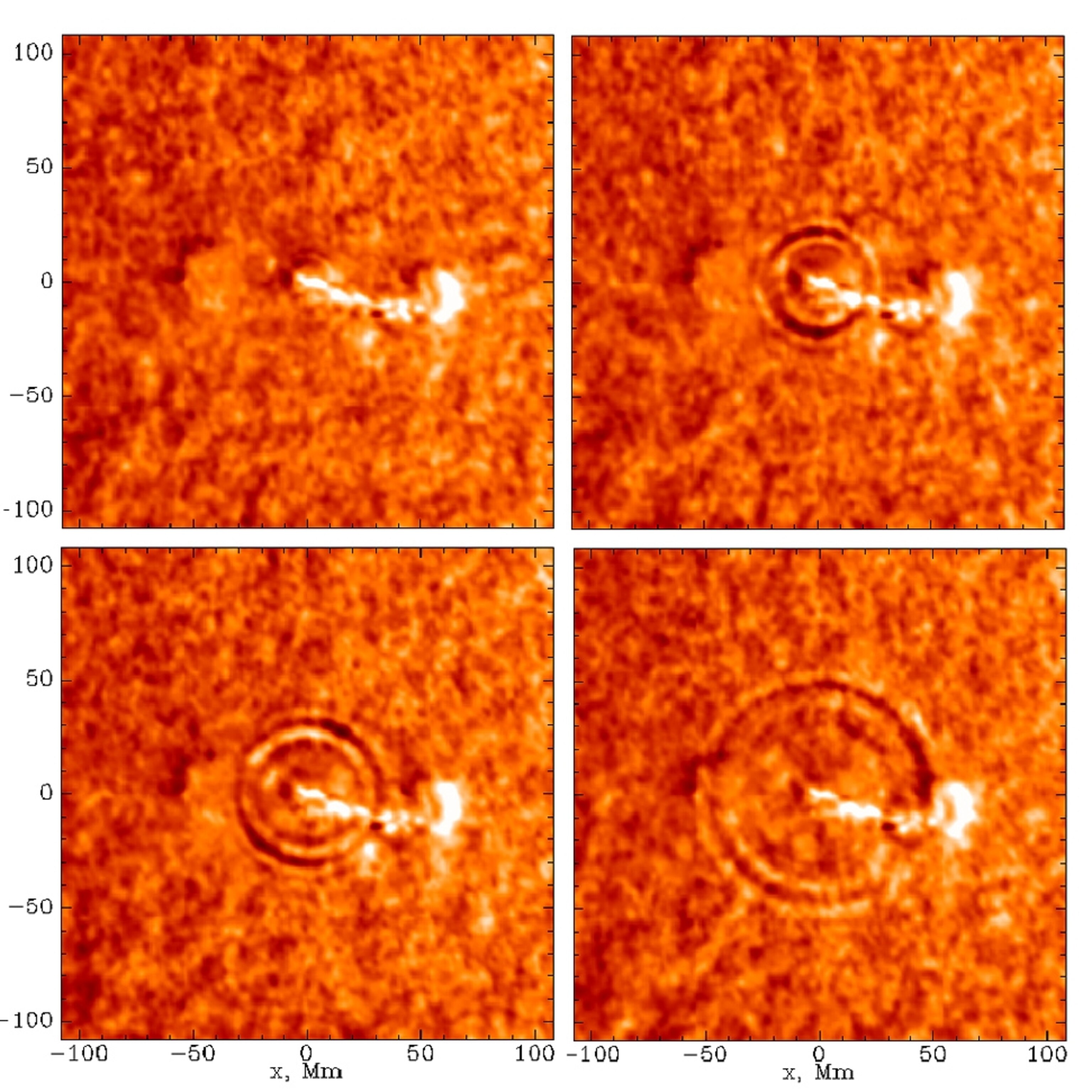
The solar equivalent of seismic waves ripple outward from a central point in a series of 1996 pictures from a NASA satellite. The images showed for the first time that solar flares produce waves of energy on the sun's surface that closely resemble the waves created by earthquakes on our planet.
However, the flare—generated "sunquake" contained about 40,000 times the energy released by the great earthquake that rocked San Francisco in 1906.
-
Sun Snake
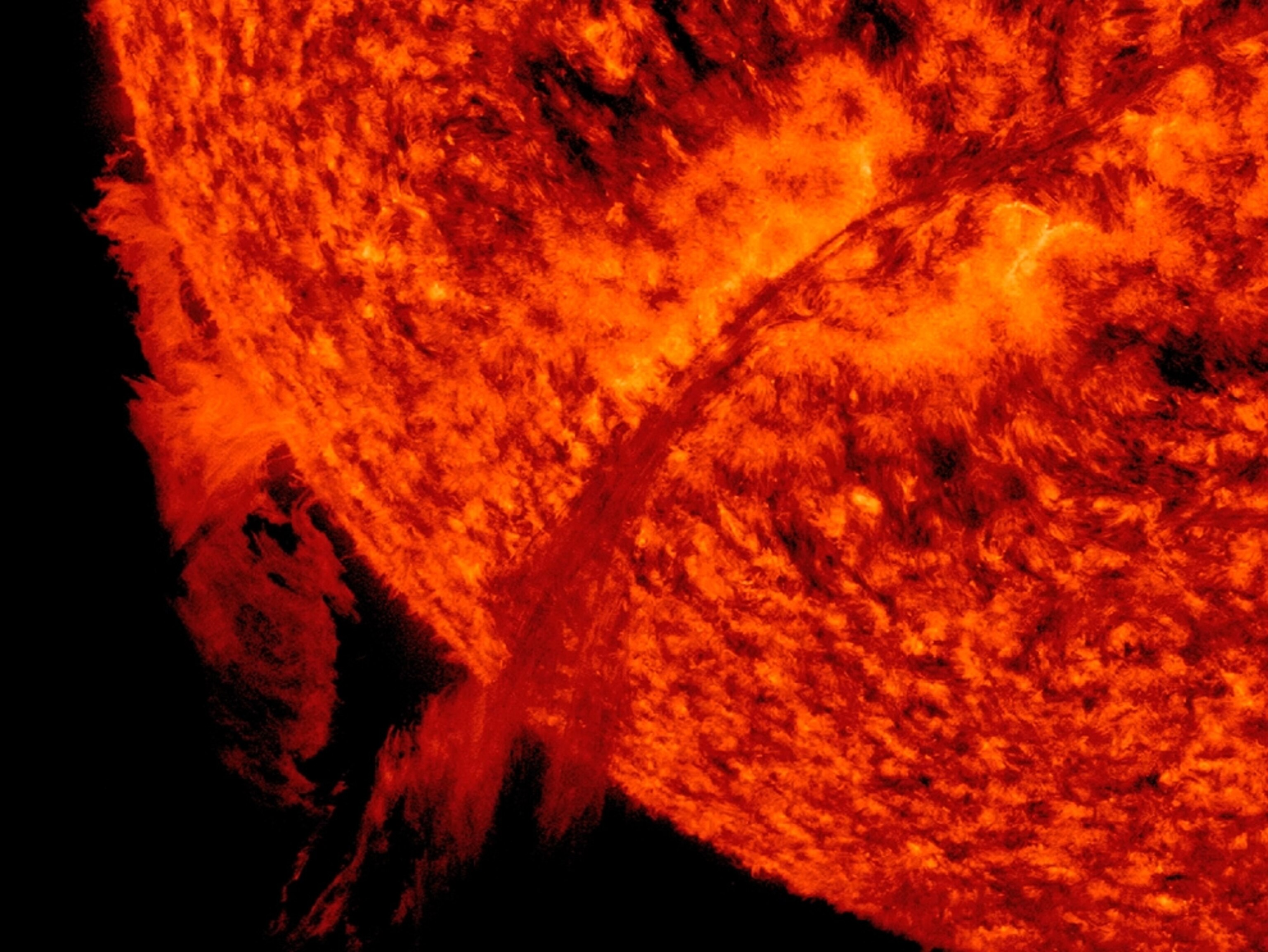
Photograph courtesy SDO/NASAA solar filament snakes around the sun in a December 2010 picture taken by a NASA satellite. The filament was more than 620,000 miles (a million kilometers) long—more than half as wide as the sun—and was visible for more than two weeks before it rotated out of view.
Solar filaments are not very stable and often break away from the sun, releasing plasma clouds that eventually dissipate in space.
Shop National Geographic
ScienceBlogs Picks
-
Steady Hands and Fins
Photographer David Doubilet photographs stingrays, sharks, and more.
-
Survival Guide: Dodging Locusts
Swarm behaviorist Iain Couzin has a toxic reaction to a locust at the same time his team runs out of food.
Advertisement
Explore More From Nat Geo
-
Rocket City Rednecks
Wednesdays at 9P and 9:30P
Meet a group of backwoods Alabama geniuses who tackle problems with hillbilly ingenuity.
-
Mad Scientists
Wednesdays at 10P and 10:30P
Travel across America with host John Bowler as he seeks out the weirdest inventions.
National Geographic Magazine
-
Solar Storms Pictures
The space-weather forecast for the next few years: solar storms, with a chance of catastrophic blackouts on Earth. Are we prepared?
-
Terra-Cotta Army Pictures
Archaeologists and artists, armed with the latest tools and techniques, are bringing the life-size army of painted clay soldiers back to life.
-
Visions Pictures
Each month, National Geographic magazine features breathtaking photographs in Visions of Earth. Browse through visions of the world as seen through a photographer's eye.
-
Steady Hands and Fins
Photographer David Doubilet photographs stingrays, sharks, and more.
-
Survival Guide: Dodging Locusts
Swarm behaviorist Iain Couzin has a toxic reaction to a locust at the same time his team runs out of food.