Main Content
-
Dimetrodon
Artwork by Interfoto Pressebildagentur/Alamy
A sail-backed dimetrodon forages amid a Permian landscape in this artist's depiction. These primitive predators, though dinosaur-like in appearance, are actually considered the forerunners of mammals. Scientists think their large back fins were used to regulate body temperature.
-
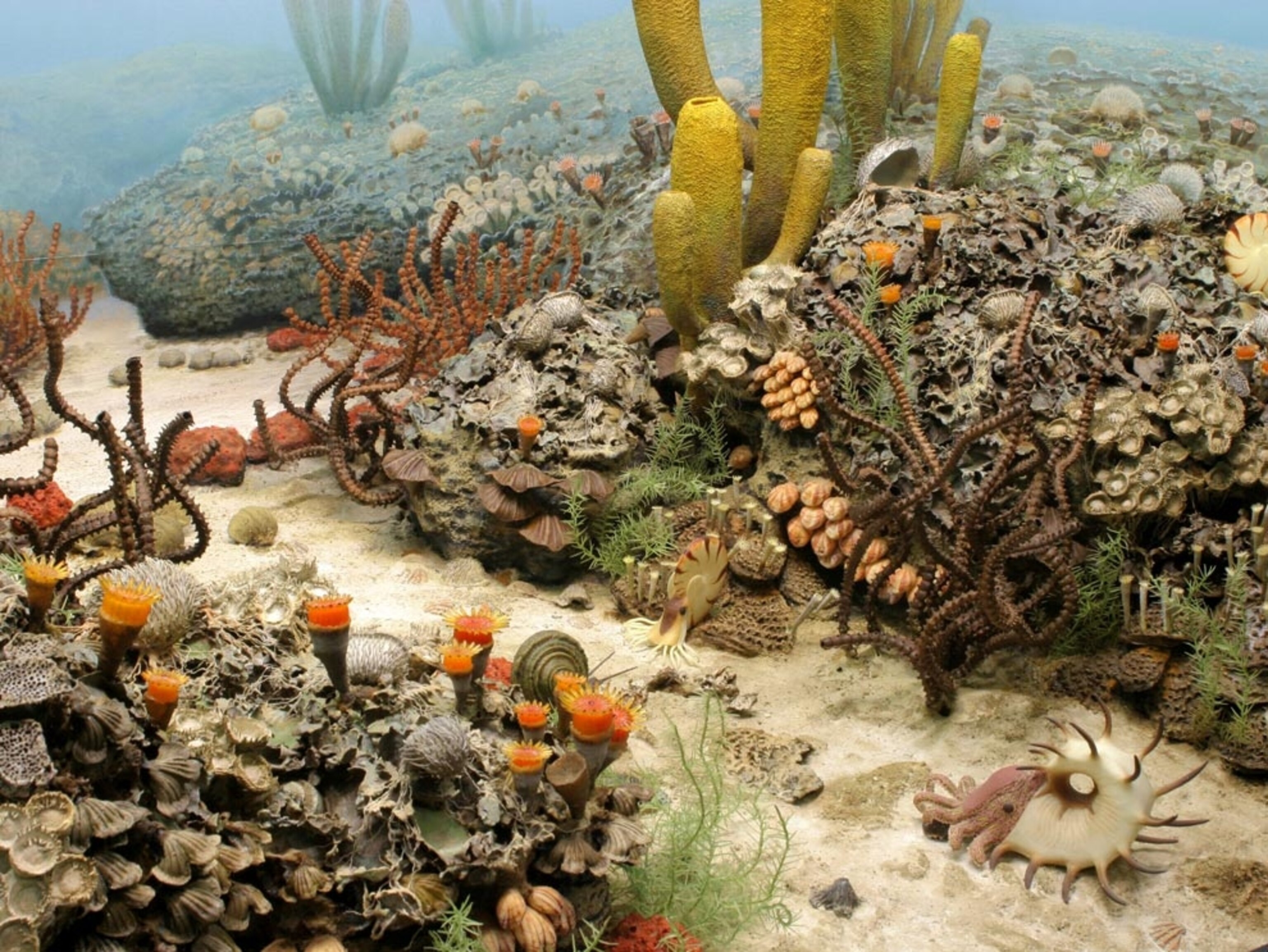
Permian Seafloor
Photograph by University of Michigan Exhibit Museum of Natural History
The Permian period saw the creation of the supercontinent Pangaea, where shallow seas in and around the huge landmass offered a home to an abundance of life. This diorama at the University of Michigan's Museum of Natural History shows some of the flora and fauna that thrived in Permian seas, including trilobites, gastropods, clams, nautiluses, and corals.
-
Swimming Nautilus
Photograph by Stuart Westmoreland
Nautiluses, like this one swimming in the waters off Palau, Micronesia, have changed little in their 270-million-year history. The first nautiluses appeared during the Permian period and were among only a handful of organisms to survive the widespread extinctions that wiped out nearly 95 percent of life on Earth about 250 million years ago.
-
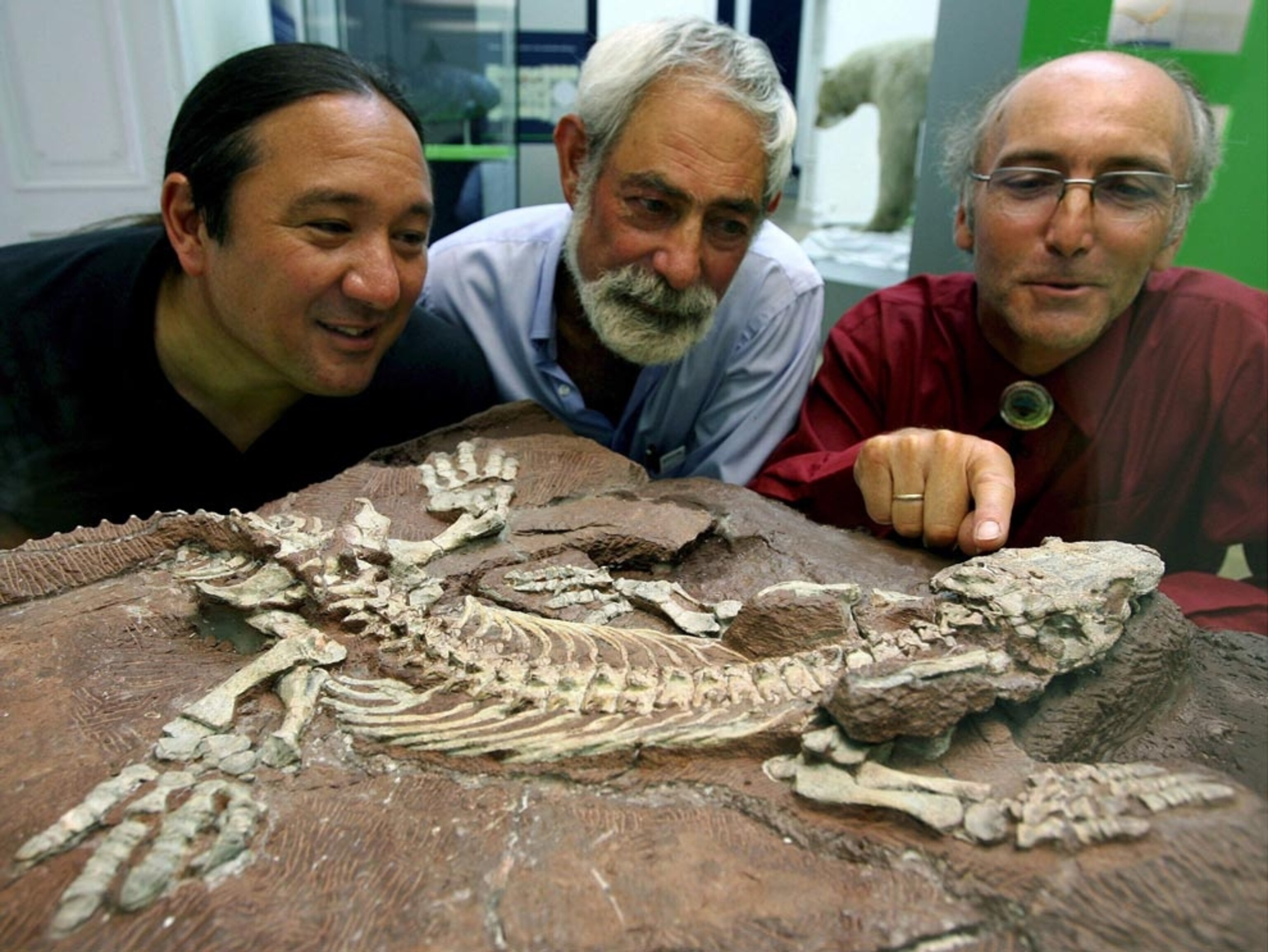
Paleontologists With Fossil
Photograph by Martin Schutt/epa/Corbis
Paleontologists (from left) Stuart Sumida, David Berman, and Thomas Martens examine the fossilized remains of a young Orobates pabsti, an ancient herbivorous reptile that lived some 290 million years ago at the beginning of the Permian. The remains were found in 2006 at Germany's Bromacker Quarry, one of the world's most productive sites for Permian-era fossil finds.
-
Lystrosaurs
Artwork by John Sibbick
An artist's depiction shows lystrosaurs foraging near a stream. Flat-faced with a beak and two teeth that resembled tusks, lystrosaurs were synapsids, animals that arose in the Permian and eventually gave rise to mammals.
-
Dinogorgon Skull
Photograph by Jonathan Blair
A quarter of a billion years ago, long before dinosaurs or mammals evolved, the 10-foot (0.3-meter) predator Dinogorgon, whose skull is shown here, hunted floodplains in the heart of today's South Africa. In less than a million years Dinogorgon vanished in the greatest mass extinction ever, along with about nine of every ten plant and animal species on the planet.
-
Dogbane Leaf Beetle
Photograph by George Grall
This iridescent dogbane leaf beetle, found on a black-eyed susan in Frederick, Maryland, can trace its ancestors to the lower Permian, some 260 million years ago. Beetles survived the massive Permian and Triassic extinctions as well as two subsequent global extinctions, and now, with some 350,000 identified species, they are the animal kingdom's most successful members.
-
Ginkgo Leaves
Photograph by TongRo Image Stock/Alamy
Ginkgo biloba is the only remaining species of the Ginkgoales order, which arose at the beginning of the Permian, some 280 million years ago. Also called the maidenhair tree, Ginkgo biloba trees can reach 100 feet (30 meters) in height and live more than a thousand years. Leaves from this living fossil are widely used in herbal medicines.
-
Butterloch Canyon
Photograph by Jonathan Blair/Corbis
Scientists studying the Permian extinctions scale the loose rocks of Butterloch Canyon in Italy's Dolomites. Exposed fossil beds here offer relatively easy access to the transition point from the Permian to the Triassic. Rock layers at this boundary contain large amounts of fossilized wood-eating fungi, strongly suggesting that a massive die-off of trees occurred during this time.
-
Guadalupe Mountains
Photograph by Jonathan Blair/Corbis
The Guadalupe Mountains in Texas are home to one of the world's largest exposed fossil reefs, a 400-mile-long (644-kilometer-long) horseshoe-shaped limestone bed laid down some 250 million years ago during the Permian period. At that time, much of what is now Texas and New Mexico was covered by a vast tropical ocean. As this sea began to evaporate, sediments entombed the reef, perfectly preserving thousands of marine fossils.
-
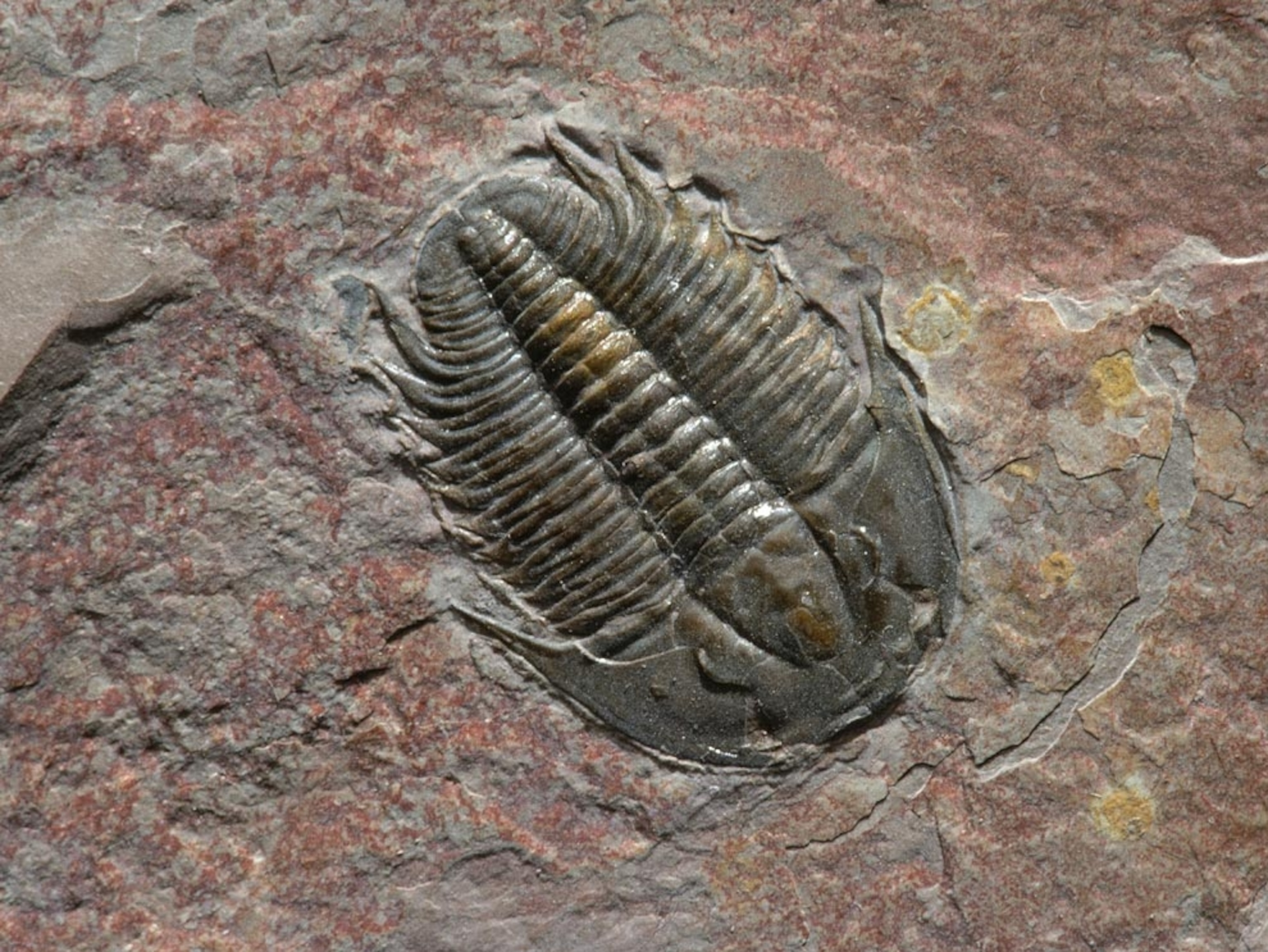
Trilobite Fossil
Photograph by James L. Amos
Trilobites, like this perfectly preserved specimen at South Dakota's Black Hills Institute of Geological Research, were among the most successful organisms ever to populate Earth. These familiar marine arthropods first arose about 545 million years ago in the early Cambrian and thrived throughout the world's oceans until they were wiped out in the Permian extinctions about 250 million years ago.
-
Permian Basin
Photograph by Sarah Leen
The Permian Basin underlies most of West Texas and part of eastern New Mexico and contains Permian sediments some 12,000 feet (3,700 meters) thick. Once the bottom of an inland Permian sea, this region is now the epicenter of Texas oil production.
Advertisement
National Geographic Blogs
-
NatGeo NewsWatch
Keep current on developments in science, nature, and cultures.
-
Breaking Orbit
Join a discussion of all things extraterrestrial.
-
BlogWild
National Geographic explorers share tales (and photos) of their adventures.
-
Stones, Bones 'n Things
Go behind the scenes of new discoveries with National Geographic scientists.
-
Ocean Now
Join underwater explorer Enric Sala as he explores untouched reefs.
Special Ad Section
-
Sweepstakes
Enter to win a trip to Fort Worth, Texas, and spend a day with a National Geographic photographer!
-
Enter Sweepstakes
See photos of Montana and enter for a chance to win a trip for two!