-
Jupiter’s Moon Io
Photograph courtesy John Spencer (Lowell Observatory) and NASA
In 1999, to commemorate the ninth anniversary since its launch, the Hubble Space Telescope took this dramatic snapshot of Jupiter’s moon Io and its shadow sweeping across the gas giant’s turbulent atmosphere. About the size of Earth’s moon, Io is the most volcanic body in the solar system and orbits 500,000 kilometers above the planet’s cloud tops.
Rovio takes its popular game to the final frontier with Angry Birds Space, launching March 22, in partnership with National Geographic Books and NASA.
Purchase the official companion book National Geographic Angry Birds Space.
-
Cat’s-Eye Nebula
Photograph courtesy J.P. Harrington and K.J. Borkowski (University of Maryland), and NASA
This 1995 portrait of the Cat’s-Eye Nebula in the Draco constellation is considered one of the most iconic photos taken by the Hubble Space Telescope. Also known as NGC 6543, it is a classic planetary nebula that glows by the high-energy emissions thrown off by the star seen at the center of the gas cloud.
This false color image shows off the intricate bubbles and twisted features within the 0.2-light-year-wide expanding shell of gas blasted out by a dying sun 3,000 light-years away.
Rovio takes its popular game to the final frontier with Angry Birds Space, launching March 22, in partnership with National Geographic Books and NASA.
Purchase the official companion book National Geographic Angry Birds Space.
-
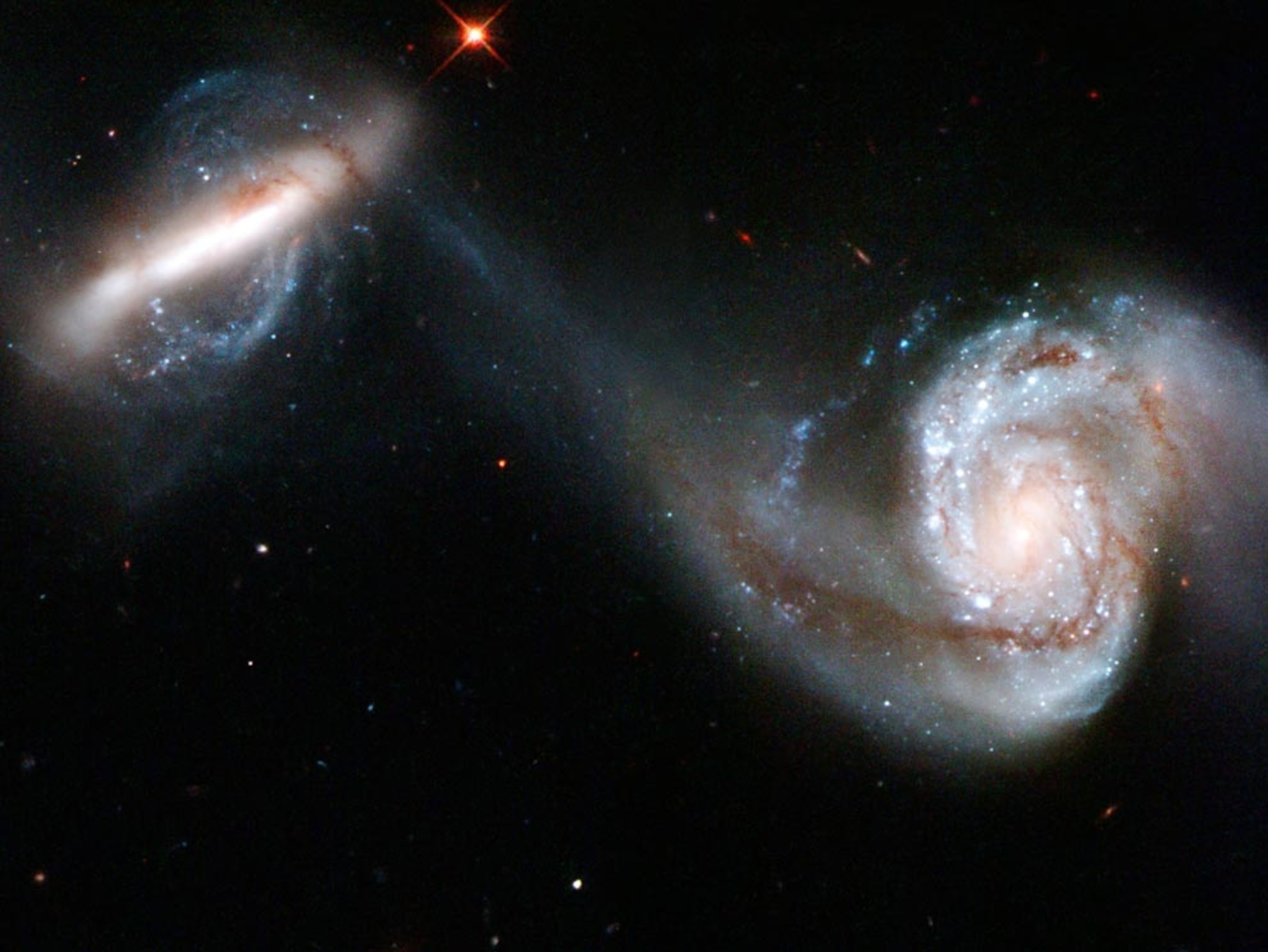
A "Rose" Made of Galaxies
Photograph courtesy NASA, ESA, and the Hubble Heritage Team (STScI/AURA)
Looking more like a delicate flower on a stem, a pair of interacting galaxies known as Arp 273 lie 300 million light-years away in the northern constellation Andromeda. Despite its tranquil appearance, the larger spiral galaxy at the top of this 2011 Hubble image is in the process of being gravitationally ripped apart by its smaller companion galaxy. Connecting the two galaxies is a threadlike stream of stars stretching tens of thousands of light-years.
Rovio takes its popular game to the final frontier with Angry Birds Space, launching March 22, in partnership with National Geographic Books and NASA.
Purchase the official companion book National Geographic Angry Birds Space.
-
Carina Nebula
Photograph courtesy NASA, ESA, and M. Livio and the Hubble 20th Anniversary Team (STScI)
This craggy fantasy mountaintop enshrouded by wispy clouds looks like a bizarre landscape from J.R.R. Tolkien's The Lord of the Rings or a Dr. Seuss book, depending on your imagination. The NASA Hubble Space Telescope image, which is even more dramatic than fiction, captures the chaotic activity atop a three-light-year-tall pillar of gas and dust that is being eaten away by the brilliant light from nearby bright stars. The pillar is also being assaulted from within, as infant stars buried inside it fire off jets of gas that can be seen streaming from towering peaks.
This turbulent cosmic pinnacle lies within a tempestuous stellar nursery called the Carina Nebula, located 7,500 light-years away in the southern constellation Carina. The image celebrates the 20th anniversary of Hubble's launch and deployment into an orbit around Earth.
Rovio takes its popular game to the final frontier with Angry Birds Space, launching March 22, in partnership with National Geographic Books and NASA.
Purchase the official companion book National Geographic Angry Birds Space.
-
Cat's-Eye Nebula
Photograph courtesy NASA, ESA, HEIC, and The Hubble Heritage Team (STScI/AURA)
In 2004 Hubble revisited the psychedelic gas bubble known as the Cat’s-Eye Nebula, revealing at least 11 previously unknown concentric rings and knots of glowing gas blown out into space by a dying sunlike star. This new high-resolution image revealed to astronomers that shells of stellar material are expelled in 1500-year intervals, creating a cosmic structure similar to layers of onion skin.
Rovio takes its popular game to the final frontier with Angry Birds Space, launching March 22, in partnership with National Geographic Books and NASA.
Purchase the official companion book National Geographic Angry Birds Space.
-
Red Supergiant Star
Photograph courtesy NASA, ESA and H.E. Bond (STScI)
Located 20,000 light-years away at the edge of the Milky Way galaxy, this red star—complete with dusty cloak—caught the eye of Hubble in 2002 and again in 2005 in the above image, revealing dramatic changes in the illumination of the surrounding cloud.
V838 Monocerotis is a red supergiant star that mysteriously produces multiple flashes of light over time, illuminating different layers of the surrounding gas and dust. This phenomenon, known as a light echo, was first seen by Hubble and may represent a previously unknown, unstable phase in aging stars many times the mass of our sun.
Rovio takes its popular game to the final frontier with Angry Birds Space, launching March 22, in partnership with National Geographic Books and NASA.
Purchase the official companion book National Geographic Angry Birds Space.
-
Jupiter's Moon Ganymede
Photograph courtesy NASA, ESA, and E. Karkoschka (University of Arizona)
As if playing a cosmic game of peekaboo, Jupiter’s largest moon, Ganymede, is caught by Hubble’s camera in 2007 just before it slips behind the planet.
Images like these help astronomers study the gas giant’s upper atmosphere. Reflected sunlight off the surface of the disappearing moon has to pass through Jupiter's upper cloud deck and atmospheric haze before reaching Hubble detectors, imprinting on the light the chemical fingerprints of the gas giant's atmosphere.
Rovio takes its popular game to the final frontier with Angry Birds Space, launching March 22, in partnership with National Geographic Books and NASA.
Purchase the official companion book National Geographic Angry Birds Space.
-
Cone Nebula
Photograph courtesy NASA, H. Ford (JHU), G. Illingworth (USCS/LO), M. Clampin (STScI), G. Hartig (STScI), and the ACS Science Team
Looking like a mythical beast rearing its ugly head from a red sea in this famous 2002 Hubble photo, the Cone Nebula is actually a gigantic star-forming region 2,500 light-years away. While the entire nebula extends out to seven light-years across, the above image centers only on the 2.5-light-year-long, cone-shaped pillar of gas that dominates the gas cloud. Intense ultraviolet radiation emitted by newborn stars hidden within the nebula give rise to the eerie red glowing halo seen surrounding the cone structure.
Rovio takes its popular game to the final frontier with Angry Birds Space, launching March 22, in partnership with National Geographic Books and NASA.
Purchase the official companion book National Geographic Angry Birds Space.
-
Rare Galaxy Alignment
Photograph courtesy NASA and The Hubble Heritage Team (STScI/AURA)
In 2000, Hubble captured a rare alignment of two galaxies, known collectively as NGC 3314. Two large spiral galaxies sitting 130 million light-years away appear to be lined up one behind the other, offering astronomers an opportunity to pick out dark dusty lanes in the foreground galaxy, which is silhouetted on top of the more distant background galaxy.
Rovio takes its popular game to the final frontier with Angry Birds Space, launching March 22, in partnership with National Geographic Books and NASA.
Purchase the official companion book National Geographic Angry Birds Space.
-
Hubble Telescope's Cosmic Eskimo
Image courtesy NASA
Resembling a human head in a parka, this shot of the Eskimo Nebula is one of Hubble's most iconic photos. The colorful gas cloud 5,000 light-years away represents the remnants of a sunlike star exploding 10,000 years ago. The outer region of this planetary nebula contains a radiating pattern of orange-colored gaseous filaments stretching more than a light-year out; however, astronomers still can't explain how exactly they formed.
Rovio takes its popular game to the final frontier with Angry Birds Space, launching March 22, in partnership with National Geographic Books and NASA.
Purchase the official companion book National Geographic Angry Birds Space.
-
Mars Polar Cap
Photograph courtesy NASA
Located above the blurring effect of Earth's atmosphere, the Hubble Space Telescope has been able to get some of the sharpest views of neighboring planet Mars. This 1999 portrait, captured by the telescope when the red planet was on a close approach to Earth, shows surface features as small as 12 miles across.
Highlights of this image include an icy north polar cap flanked on the left by a giant storm composed of ice water clouds, and, just below the cap, a dark region made of sand dunes formed of ancient, pulverized volcanic rocks.
Rovio takes its popular game to the final frontier with Angry Birds Space, launching March 22, in partnership with National Geographic Books and NASA.
Purchase the official companion book National Geographic Angry Birds Space.
-
Rebel Angel
Image courtesy ESA/NASA
A cosmic angel seems to spread its shimmering wings in a newly released Hubble Space Telescope picture of the star-forming region called Sh 2-106.
The cloud of dust and gas is being shaped by a young star called S106 IR. On the cusp of adulthood, the growing star is "rebelling" against its parent cloud, ejecting material at high speeds and creating glowing lobes of hot, turbulent hydrogen gas.
Rovio takes its popular game to the final frontier with Angry Birds Space, launching March 22, in partnership with National Geographic Books and NASA.
Purchase the official companion book National Geographic Angry Birds Space.
-
Hubble Bubble
Image courtesy ESA/NASA
Like a ghostly bubble hanging in space, SNR 0509-67.5 is the last gasp of a massive star snuffed out in a titanic explosion 400 years ago.
In 2012, Hubble spied this 23-light-year-wide supernova blast wave expanding at speeds of 11 million miles per hour. It is located in a Milky Way satellite galaxy called the Large Magellanic Cloud, about 170,000 light-years from Earth.
Rovio takes its popular game to the final frontier with Angry Birds Space, launching March 22, in partnership with National Geographic Books and NASA.
Purchase the official companion book National Geographic Angry Birds Space.
-
Neptune
Photograph courtesy NASA, ESA, E. Karkoschka (University of Arizona), and H.B. Hammel (Space Science Institute, Boulder, Colorado)
Even after more than 200 years of observations through telescopes, Neptune remains a planet shrouded in mystery. Nearly three billion kilometers away from the blue-green gas giant, Hubble's keen digital eye has been able to resolve atmospheric detail in Neptune's upper atmosphere. Surrounded by a retinue of moons, high-altitude clouds composed of methane ice crystals near the northern polar region are revealed in this 2005 image.
Rovio takes its popular game to the final frontier with Angry Birds Space, launching March 22, in partnership with National Geographic Books and NASA.
Purchase the official companion book National Geographic Angry Birds Space.
-
Ursa Major Spiral Galaxy
Photograph courtesy NASA and the Hubble Heritage (STScI/AURA)-ESA/Hubble Collaboration
Tucked away within the northern constellation of Ursa Major is this 46 million light-year distant galaxy that astronomers believe may be a Milky Way look-alike. Hubble snapped this image of the spiral galaxy NGC 2841 in 2010, showing off its sweeping arms filled with dust lanes and star-forming clouds.
Rovio takes its popular game to the final frontier with Angry Birds Space, launching March 22, in partnership with National Geographic Books and NASA.
Purchase the official companion book National Geographic Angry Birds Space.
-
Eye-Shaped Planetary Nebula
Photograph courtesy Bruce Balick, Jason Alexander, Arsen Hajian, Yervant Terzian, Mario Perinotto, Patrizio Patriarchi, and NASA
This eyelike appearance is marred by two sets of blood-red "fliers" that lie horizontally across the image. The surrounding faint green "white" of the eye is believed to be gas that made up almost half of the star's mass for most of its life. The hot remnant star (in the center of the green oval) drives a fast wind into older material, forming a hot interior bubble that pushes the older gas ahead of it to form a bright rim. (The star is one of the brightest stars in any planetary nebula.) NGC 6826 is 2,200 light-years away in the constellation Cygnus.
Rovio takes its popular game to the final frontier with Angry Birds Space, launching March 22, in partnership with National Geographic Books and NASA.
Purchase the official companion book National Geographic Angry Birds Space.
-
Crab Nebula
Photograph courtesy NASA, ESA, J. Hester and A. Loll (Arizona State University)
Considered the most detailed image ever taken of the famous Crab Nebula, this Hubble portrait shows off countless wispy, branchlike filaments of hydrogen gas throughout the supernova explosion remnant. The electric-blue coloring of the interior of the cloud is the naked core of the dead star at the heart of the Crab Nebula.
Ancient Chinese astronomers witnessed the supernova explosion that gave birth to the nebula in A.D. 1054; records indicate there was a new bright star visible in the sky for two weeks.
Rovio takes its popular game to the final frontier with Angry Birds Space, launching March 22, in partnership with National Geographic Books and NASA.
Purchase the official companion book National Geographic Angry Birds Space.
-
Cassiopeia A
Photograph courtesy NASA and The Hubble Heritage Team (STScI/AURA)
Hubble snapped this 2002 image of what looks like Fourth of July fireworks but is in fact the remnants of a titanic stellar explosion expanding out into space. Considered the youngest supernova in the entire galaxy, gaseous streamers of purple, green, and yellow highlight Cassiopeia A 10,000 light-years away.
Rovio takes its popular game to the final frontier with Angry Birds Space, launching March 22, in partnership with National Geographic Books and NASA.
Purchase the official companion book National Geographic Angry Birds Space.
-
Reflection Nebula
Photograph courtesy NASA, ESA, and H. Bond (STScI)
The shadowy form at the center of this snapshot from Hubble is an actual hole within a thick cloud of gas and dust 1,500 light-years away in the winter constellation Orion. Like a streetlamp lighting up surrounding fog, the reflection nebula NGC 199 shines only because of the hot, young star off to the left of the dark hole.
Rovio takes its popular game to the final frontier with Angry Birds Space, launching March 22, in partnership with National Geographic Books and NASA.
Purchase the official companion book National Geographic Angry Birds Space.
-
A Pinwheel-Shaped Galaxy
Photograph courtesy NASA, ESA, The Hubble Heritage Team, (STScI/AURA) and A. Riess (STScI)
With spiral arms dominated by young blue stars and a core filled with an older yellow star population, this 100 million light-year distant galaxy takes center stage in this dramatic 2006 photo by the Hubble Space Telescope.
Spanning only 30,000 light-years across, NGC 1309 is a compact spiral only one-third the size of our Milky Way. Meanwhile dozens of much more distant galaxies can be seen peppering the background of this image.
Rovio takes its popular game to the final frontier with Angry Birds Space, launching March 22, in partnership with National Geographic Books and NASA.
Purchase the official companion book National Geographic Angry Birds Space.
-
Colliding Galaxies Stream Stars and Gas
Photograph courtesy NASA, H. Ford (JHU), G. Illingworth (UCSC/LO), M.Clampin (STScI), G. Hartig (STScI), the ACS Science Team, and ESA
Astronomers believe this Hubble photograph offers a preview of what is in store for our Milky Way and Andromeda galaxies billions of years from now. Known affectionately as "the mice" because of their long, rodent-like tails of stars and dust, the two galaxies, known collectively as NGC 4676, are seen colliding into each other 300 million light-years away. Astronomers using supercomputer models show that the two galaxies will eventually merge into one galaxy some 400 million years from now.
Rovio takes its popular game to the final frontier with Angry Birds Space, launching March 22, in partnership with National Geographic Books and NASA.
Purchase the official companion book National Geographic Angry Birds Space.
-
Red Rectangle Nebula
Photograph courtesy NASA; ESA; Hans Van Winckel (Catholic University of Leuven, Belgium); and Martin Cohen (University of California, Berkeley)
Ground-based telescopes make the nebula pictured here look rectangular in shape, hence its name: the Red Rectangle. But images taken by the Hubble Space Telescope revealed that it should more accurately be called the "Red X" Nebula. The nebula's unique shape comes from gas and dust emitted in cone-shaped bursts from the dying star at its center. This star, which began shedding its outer layers about 14,000 years ago, will slowly become smaller and hotter and begin to release a flood of ultraviolet light.
Rovio takes its popular game to the final frontier with Angry Birds Space, launching March 22, in partnership with National Geographic Books and NASA.
Purchase the official companion book National Geographic Angry Birds Space.
-
Quadruple Saturn Moon
Photograph courtesy NASA, ESA, and the Hubble Heritage Team
Planet Saturn, along with several of its moons, poses for a Hubble close-up in this 2009 portrait. Taken in 2009 when the gas giant was 775 million miles from Earth, this image shows details as small as 190 miles across.
The large, orange disk is Saturn's moon Titan, which is larger than planet Mercury. Closer to the rings, a parade of three smaller moons are also visible: from left to right, Enceladus and Dione—including their dark shadows cast on Saturn's cloud tops—and Mimas, just off the planet's right side.
Rovio takes its popular game to the final frontier with Angry Birds Space, launching March 22, in partnership with National Geographic Books and NASA.
Purchase the official companion book National Geographic Angry Birds Space.
-
Light Echo
Photograph courtesy NASA, ESA, and H. Bond (STScI)
This view is of an unusual phenomenon in space called light echo. Light from a star that erupted nearly five years ago continues propagating outward through a cloud of dust surrounding the star. The light reflects, or echoes, off the dust, then travels to Earth.
Rovio takes its popular game to the final frontier with Angry Birds Space, launching March 22, in partnership with National Geographic Books and NASA.
Purchase the official companion book National Geographic Angry Birds Space.
-
Stars in Scorpius
Image courtesy NASA
The star cluster Prismis 24 hangs above the monstrous emission nebula NGC 6357, seen here in this 2006 image taken by the Hubble Space Telescope. Located 8,000 light-years from Earth in the constellation Scorpius, blazing stars some hundred times more massive than our sun lie buried within the nebula and are heating up the gas surrounding the cluster, creating the cavernous bubble visible at the bottom of the image.
Rovio takes its popular game to the final frontier with Angry Birds Space, launching March 22, in partnership with National Geographic Books and NASA.
Purchase the official companion book National Geographic Angry Birds Space.
Shop National Geographic
2011 Emerging Explorers
ScienceBlogs Picks
-
Steady Hands and Fins
Photographer David Doubilet photographs stingrays, sharks, and more.
-
Survival Guide: Dodging Locusts
Swarm behaviorist Iain Couzin has a toxic reaction to a locust at the same time his team runs out of food.
Advertisement
Angry Birds Space
-
Blast Off!
Take off with the National Geographic Angry Birds Space book as the birds fly through space on an intergalactic rescue mission.
National Geographic Magazine
-
Iceland's Resilient Beauty
Over the centuries, humans (and sheep) have taken a toll on the volcano- and glacier-shaped landscape. But what remains is still spectacular.
-
Civil War Sketches
Browse through a gallery of historical illustrations depicting both the horrors of battle and the moments of grace, as captured by skilled battlefield artists of the American Civil War.
-
Apostles Photo Gallery
They were unlikely leaders. As the Bible tells it, most knew more about mending nets than winning converts when Jesus said he would make them "fishers of men." Yet 2,000 years later, all over the world, the Apostles are still drawing people in.
-
Steady Hands and Fins
Photographer David Doubilet photographs stingrays, sharks, and more.
-
Survival Guide: Dodging Locusts
Swarm behaviorist Iain Couzin has a toxic reaction to a locust at the same time his team runs out of food.